 The National Institute of Technology (KOSEN), Gifu College, enrolls young people aged 15 years who are full of dreams and hopes, and nurtures them to become skilled persons who can contribute to society by applying science and technology through an integrated five-year hands-on and experience-oriented higher education program. National Institutes of Technology have established a “Model Core Curriculum (MCC)” of goals to be attained by the time of graduation, so that students can acquire practical skills that are internationally accepted upon graduation from any of the National Institutes of Technology (KOSEN).
We call our engineers “social doctors”. Social doctors are different from medical doctors in hospitals, because social doctors are people who can cure society to make it healthy when it is sick or prevent it from becoming sick. Social Doctors also have the aspect of being “creators” of new values, new ways of thinking, and new ways of doing things. These persons are the true “assets” for society.
Our National Institute of Technology (KOSEN), Gifu College was founded in 1963 as one of the 51 National Institutes of Technology in Japan. The school has five departments: Mechanical Engineering, Electrical and Computer Engineering, Electronic and Control Engineering, Civil Engineering, and Architecture, as well as Advanced Course (Interdisciplinary Technology Development). Approximately 9,000 graduates and 800 graduates of Advanced Course have completed their courses and are contributing to society. The characteristics of the school's education can be broadly summarized in the following three points.
The first is “deepening of understanding”. By combining the thinking experience from lectures with the practical experience from hands-on experiments, students deepen their understanding of the concepts and can freely use their knowledge according to the situations. In addition to learning theory, students develop their practical skills through hands-on experimentation.
The second is “wisdom education”. By confronting real-world issues, students develop the ability to demonstrate “wisdom” while handling problem-solving. For example, in the third year, we hold a “Business Idea-Thon” in collaboration with companies as a special activity. Students form teams with their peers, confront “real” issues at local companies, and receive direct guidance from corporate engineers to develop ideas for solving problems from a “hands-on” perspective. Through such fieldwork, students develop teamwork, communication, problem-identifying and problem-solving skills, flexible thinking, and a challenging spirit required by society. By taking on the challenge of solving real-world problems, students also develop a “great ambition” to contribute to society.
The third point is the school culture, which allows students to pursue their interests. The school offers students a variety of options to choose from according to their individual interests. For example, students can choose from a wide range of contest activities (robot contests, programming contests, design competitions, etc.), international exchange programs (over 70 students participated in study-abroad programs in England, the United States, France, Vietnam, Singapore, Taiwan, etc. in 2024), club activities (sports clubs, culture, science clubs, and other clubs), and school events. Students engage in these activities as per their interests through a wide variety of options.
Students can take on bold challenges because they can study without the hindrances of university entrance exams. As a result, they acquire abilities at par with those of university graduates. Every year, there are 30 times more job offers than the applicants, and those who wish to work find employment in leading companies. Those who wish to seek higher education are admitted in the third year to public universities such as Nagoya University, Gifu University, Nagaoka University of Technology, and Toyohashi University of Technology, which are closely related to the National Institutes of Technology, or these students go on to complete our Advanced Course.
The environment around the National Institutes of Technology (KOSEN) is changing owing to rapid progress in science and technology, declining birthrates, aging populations, globalization, climate change, and new coronary infections. Consequently, the abilities that the graduates of the National Institutes of Technology (KOSEN) are required to possess are also evolving. However, the role of National Institutes of Technology (KOSEN) in developing professionals and human resources who can significantly contribute to society will continue.
Based on our educational philosophy, we aim to nurture social doctors who are internationally minded and active at the forefront of the information society, with passion and ambition to contribute to people and society through science and technology. We will continue our efforts to improve the quality of education and research at the National Institutes of Technology (KOSEN) to strengthen regional cooperation and reform education in response to societal changes. We look forward to your continued understanding and support in this endeavor.
The National Institute of Technology (KOSEN), Gifu College, enrolls young people aged 15 years who are full of dreams and hopes, and nurtures them to become skilled persons who can contribute to society by applying science and technology through an integrated five-year hands-on and experience-oriented higher education program. National Institutes of Technology have established a “Model Core Curriculum (MCC)” of goals to be attained by the time of graduation, so that students can acquire practical skills that are internationally accepted upon graduation from any of the National Institutes of Technology (KOSEN).
We call our engineers “social doctors”. Social doctors are different from medical doctors in hospitals, because social doctors are people who can cure society to make it healthy when it is sick or prevent it from becoming sick. Social Doctors also have the aspect of being “creators” of new values, new ways of thinking, and new ways of doing things. These persons are the true “assets” for society.
Our National Institute of Technology (KOSEN), Gifu College was founded in 1963 as one of the 51 National Institutes of Technology in Japan. The school has five departments: Mechanical Engineering, Electrical and Computer Engineering, Electronic and Control Engineering, Civil Engineering, and Architecture, as well as Advanced Course (Interdisciplinary Technology Development). Approximately 9,000 graduates and 800 graduates of Advanced Course have completed their courses and are contributing to society. The characteristics of the school's education can be broadly summarized in the following three points.
The first is “deepening of understanding”. By combining the thinking experience from lectures with the practical experience from hands-on experiments, students deepen their understanding of the concepts and can freely use their knowledge according to the situations. In addition to learning theory, students develop their practical skills through hands-on experimentation.
The second is “wisdom education”. By confronting real-world issues, students develop the ability to demonstrate “wisdom” while handling problem-solving. For example, in the third year, we hold a “Business Idea-Thon” in collaboration with companies as a special activity. Students form teams with their peers, confront “real” issues at local companies, and receive direct guidance from corporate engineers to develop ideas for solving problems from a “hands-on” perspective. Through such fieldwork, students develop teamwork, communication, problem-identifying and problem-solving skills, flexible thinking, and a challenging spirit required by society. By taking on the challenge of solving real-world problems, students also develop a “great ambition” to contribute to society.
The third point is the school culture, which allows students to pursue their interests. The school offers students a variety of options to choose from according to their individual interests. For example, students can choose from a wide range of contest activities (robot contests, programming contests, design competitions, etc.), international exchange programs (over 70 students participated in study-abroad programs in England, the United States, France, Vietnam, Singapore, Taiwan, etc. in 2024), club activities (sports clubs, culture, science clubs, and other clubs), and school events. Students engage in these activities as per their interests through a wide variety of options.
Students can take on bold challenges because they can study without the hindrances of university entrance exams. As a result, they acquire abilities at par with those of university graduates. Every year, there are 30 times more job offers than the applicants, and those who wish to work find employment in leading companies. Those who wish to seek higher education are admitted in the third year to public universities such as Nagoya University, Gifu University, Nagaoka University of Technology, and Toyohashi University of Technology, which are closely related to the National Institutes of Technology, or these students go on to complete our Advanced Course.
The environment around the National Institutes of Technology (KOSEN) is changing owing to rapid progress in science and technology, declining birthrates, aging populations, globalization, climate change, and new coronary infections. Consequently, the abilities that the graduates of the National Institutes of Technology (KOSEN) are required to possess are also evolving. However, the role of National Institutes of Technology (KOSEN) in developing professionals and human resources who can significantly contribute to society will continue.
Based on our educational philosophy, we aim to nurture social doctors who are internationally minded and active at the forefront of the information society, with passion and ambition to contribute to people and society through science and technology. We will continue our efforts to improve the quality of education and research at the National Institutes of Technology (KOSEN) to strengthen regional cooperation and reform education in response to societal changes. We look forward to your continued understanding and support in this endeavor.
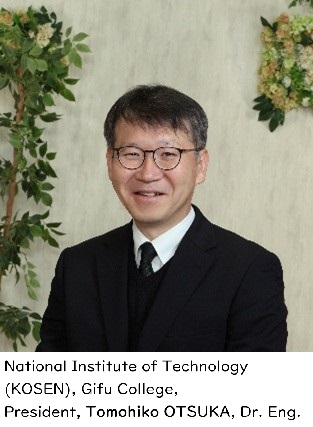
President,
National Institute of Technology (KOSEN), Gifu College,
Tomohiko OTSUKA
Message from the president